
Call us now :08071794442
 Send Inquiry
 Send Inquiry
Acrylonitrile ISI Certification
Price 45000 INR/ Number
Acrylonitrile ISI Certification Specification
- Product Name
- Acrylonitrile
- Storage Conditions
- Store in cool, dry, and well-ventilated area
- Packaging Size
- Customized
- Location
- Pan India
- Chemical Formula
- C3H3N
- Hazard Class
- 3 (Flammable Liquid)
- Mode of Report
- Hard Copy, Soft Copy
- Shelf Life
- 1 Year
- Purity
- 99% Min
- Physical State
- Liquid
- Application
- Used in the production of plastics, synthetic rubbers, and acrylic fibers
- Type Of Industry
- Manufacturer
- CAS Number
- 107-13-1
- Certification Service Type
- BIS Certification
Acrylonitrile ISI Certification Trade Information
- Minimum Order Quantity
- 30 Number
- FOB Port
- Pan India
- Payment Terms
- Cash on Delivery (COD), Cash Advance (CA), Cash in Advance (CID), Cheque
- Supply Ability
- 30 Per Month
- Delivery Time
- 30 Days
- Main Export Market(s)
- Asia, Australia, Central America, North America, South America, Eastern Europe, Western Europe, Middle East, Africa
- Main Domestic Market
- All India
- Certifications
- ISI Mark Certification
About Acrylonitrile ISI Certification
Acrylonitrile Butadiene Styrene (ABS) hasbeen included in the mandatory ISI Certification Scheme under IS standard - IS17077. This product cannot be exported/imported or sold in Indian consumermarket without ISI Mark imprinted. We provide complete ISI Certificationconsultancy services for your product from start to end, during which assistyou in all types of documentation formalities 38. Beta Picoline. All BetaPicoline has been included in the mandatory ISI Certification Scheme under ISstandard - IS 16112. This product cannot be exported/imported or sold inIndian consumer market without ISI Mark imprinted. We provide complete ISICertification consultancy services for your product from start to end, duringwhich assist you in all types of documentation formalities.
Why ISI Certification Matters for Acrylonitrile
ISI Certification from the Bureau of Indian Standards establishes that Acrylonitrile meets strict safety and quality criteria. It protects manufacturers and users by verifying product compliance with chemical industry regulations, especially for hazardous substances like flammable liquids. This assurance fosters trust among clients and trading partners, promoting the responsible use and distribution of Acrylonitrile across multiple sectors in India.
Process for Obtaining BIS Certification
The BIS certification process involves the submission of technical documents, physical and chemical analysis, and factory inspections. Applicants-such as manufacturers, suppliers, or dealers-should ensure that Acrylonitrile meets prescribed standards for purity and packaging. After successful evaluation, a certificate is issued in hard and soft copies, valid throughout India. This enables legal and efficient movement of Acrylonitrile in the market.
FAQ's of Acrylonitrile ISI Certification:
Q: How can I apply for ISI Certification for Acrylonitrile in India?
A: To apply for ISI Certification, contact the Bureau of Indian Standards (BIS) directly. Submit the required documents detailing chemical composition, purity, packaging, and safety measures. The process may include sample analysis and a factory inspection before certification is granted.Q: What is the benefit of BIS certification for Acrylonitrile manufacturers and suppliers?
A: BIS certification demonstrates compliance with national regulations, boosting credibility with customers and trading partners. It facilitates safer handling, legal distribution, and stronger market acceptance for Acrylonitrile across India.Q: What storage conditions are necessary for certified Acrylonitrile?
A: Certified Acrylonitrile must be stored in a cool, dry, and well-ventilated area to ensure safety and maintain its quality. Proper storage also helps comply with hazard regulations for flammable liquids.Q: When will I receive my BIS Certificate and in what format?
A: Once your application is approved and all evaluation is complete, the BIS Certificate for Acrylonitrile is issued as both a hard copy and a soft copy. This documentation is valid for regulatory and trade purposes throughout India.Q: What industries commonly utilize certified Acrylonitrile and why?
A: Certified Acrylonitrile is widely used in the production of plastics, synthetic rubbers, and acrylic fibers due to its high purity and reliable chemical properties. Industries benefit from compliance assurance and enhanced product safety.Q: Where does ISI Certified Acrylonitrile find application geographically within India?
A: ISI Certified Acrylonitrile is authorized for use, sale, and export across all regions of India, accessible to manufacturers, distributors, exporters, importers, traders, and wholesalers.Q: What is the shelf life of certified Acrylonitrile, and what should be done towards end of life?
A: Certified Acrylonitrile has a shelf life of one year when stored under recommended conditions. Expired material should be handled according to local hazardous waste disposal regulations to ensure environmental and operational safety.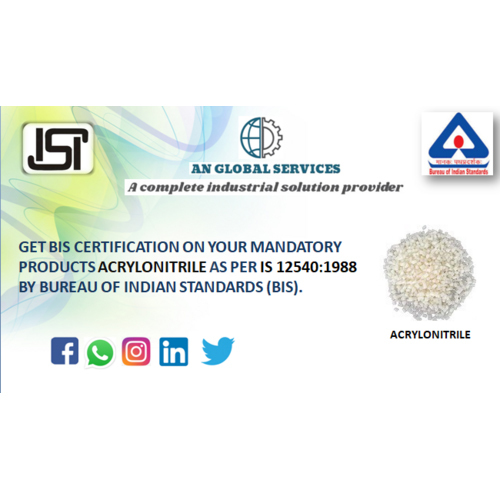
Tell us about your requirement

Price:
Quantity
Select Unit
- 50
- 100
- 200
- 250
- 500
- 1000+
Additional detail
Mobile number
Email

More Products in ISI Certification Services Category
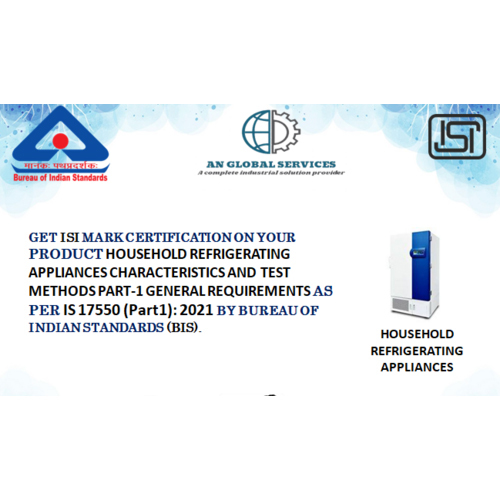
Household Refrigerating Appliances ISI Certification
Price 45000 INR / Number
Minimum Order Quantity : 30
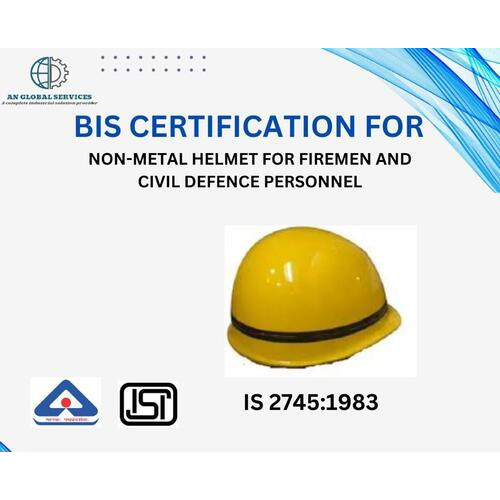
Mandatory BIS/ISI certification on Non metal helmet for firemen and civil defence personnel
Price 50000 INR / Number
Minimum Order Quantity : 1 Number

 Send Inquiry
Our Products
- ISI Certification Services
- ISI Marking Services
- BIS Registration Services
- Solar Panel Certification Services
- WPC Certification Services
- Hallmarking Services
- Laser Soldering Machine
- HDPE Tarpaulin
- EPR Registration Services
- NABL Consultancy Services
- Laboratory Equipment
- MSME Registration Services
- Trademark Registration Services
- Calibration Certification Services
- Solar Panel Testing Service
- BEE Registration Services
- TEC Certification Services
- Gold Hallmarking Registration Services
- Testing Equipment
- Handicapped Tricycle
- Organic Makhana
- Protein
- Sanitary napkins
- Adult diaper
- Baby diaper
- Lactose 200 mesh


UNIT NO. S-63, 7th FLOOR, URBTECH NPX, PLOT NO. C-1, SECTOR-153, Sector 153, Noida, Gautambuddha NagarNoida - 201310, Uttar Pradesh, India

Mr Aayush Sharma
(Founder & CEO)
Mobile :08071794442
 Send Inquiry
 Send SMS
Developed and Managed by Infocom Network Private Limited.
